

Close management
Every close teaches the next one.
The close runs as a plan you can see. AI drafts it from how your last closes actually went and from your own procedures; a controller accepts it before anything begins. What happens this month shapes next month's draft.
Every close, the same loop.
- May 2026 · 5.9 days · 2 tasks rejectedprior close
- Revenue cutoff – FY26approved procedure
- Monthly close template · v4template
June 2026 – drafted plan
- Recurring accrualsAR
- Bank reconciliationJL
- Revenue cutoffCB
drafted · accepted by the controller
- automatedDeferred revenue rollforward · run attached
- anomalyBank reconciliation ran 2.1 days over its usual pace
- sign-offPost commission accrual · sign-off · audit logged
The month, laid out.
Every task sits on its due date across the month, hand-offs drawn between them and today marked. It's the close laid out on a calendar that keeps itself – nobody maintains it by hand.
See who's carrying the close.
Capacity lays out each person's open work and the hours behind it, one lane each. Alex Rivera is carrying 38 estimated hours to everyone else's ten or fewer – the overload made visible before it bites.
Ask the close a plain question.
Ask a question about the close in plain language and read the answer the same way – what's blocking it, which tasks are behind, how you're pacing. The same view watches for unusual patterns and explains them in a line: “Alex Rivera was assigned 53% of this period's tasks – consider rebalancing the workload.”
The close, with evidence attached.
Every task carries its attachments, its comments, and an append-only audit trail – who did what, when – enforced in the database. For nine of the tasks the work executes on its own, and its proof lands on the task the same way. Sign-off keeps a separation of duties, so the reviewer is never the preparer.
What June will teach July.
Everything this close turned up – the task added halfway through, the reconciliation a reviewer sent back – is what next month's draft is built from. July's plan already carries both: the FX revaluation true-up that appeared mid-June, and the deferred-revenue reconciliation kept under review.
- Added mid-closeFX revaluation true-up
- Changes requestedReconcile deferred revenue
- July draft39 tasks
The plan keeps itself current.
The plan arrives drafted from your last closes and your own procedures, and a controller accepts it before anything starts. When a procedure changes, the draft carries it into the template – so next month opens current, not from a blank page.
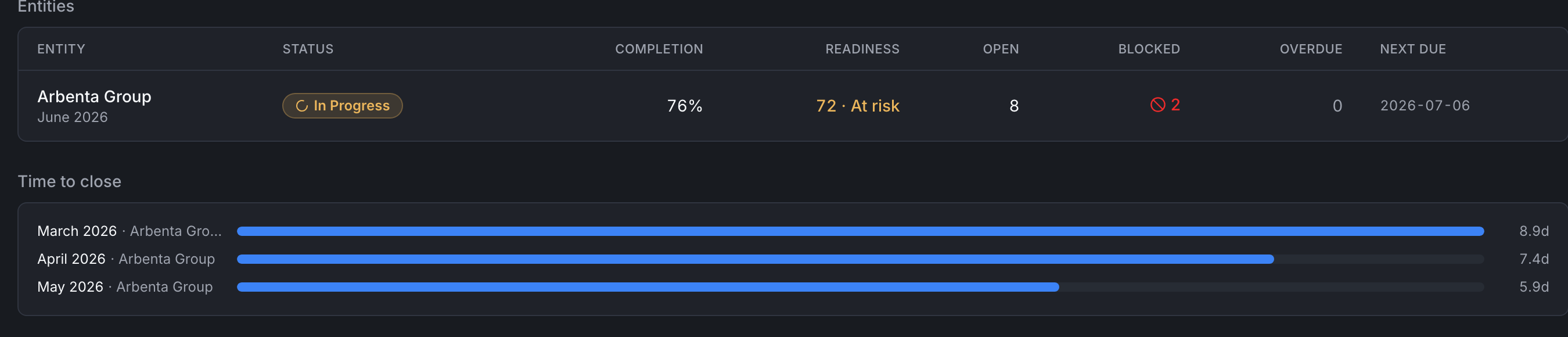
Every entity, one view.
Readiness, open work, blockers, and the next due date for every entity in one place – the closes that need you sorted to the top.
Early pilot
We're onboarding a handful of early teams.
Tell us where your close hurts. That answer doesn't go to a sales queue – it goes to the founders who write the roadmap. Pilot teams get early access, and first say in what we build next.