

AI that shows its work.
In accounting, a number you can't trace is a number you can't use. On Assertion, every number traces to its source – so your reviewer can sign off.
Execution stopped being the hard part.
Pulling data, matching transactions, drafting schedules, applying policy – AI has become genuinely good at the work of preparation. The excitement is earned.
The blocker isn't AI capability. It's the ability to review.
In accounting, work is done when a reviewer can stand behind it. As AI-enabled preparation gets faster, everything that matters concentrates in the step that hasn't changed: review.
Inquiry alone was never sufficient.
A script leaves a number and the code that produced it – and for most reviewers that is the same as leaving nothing. Ask what it did, and accounting has never accepted inquiry alone as evidence. Reperform it in a spreadsheet, and you have done the work twice. Work you can't inspect is work you can't sign off on.
Most accounting AI today
Review by inquiry
"Why is Jordan's June commission 7,490.00?"
"The Silver tier rate was applied to June revenue."
…and that's where it ends – there is nothing to open, so there is nothing to check the answer against.
Review by reperformance
Recalculates – but you've just reperformed the run in a spreadsheet. The time the automation saved, you spent proving it.
On Assertion
Review by inspection
"Why is Jordan's June commission 7,490.00?"
The same question – answered with something you can open and walk yourself. Ask why, and the answer cites the same trace: inquiry on top of inspection, not instead of it.
Python is not a working paper.
Accounting documentation has always carried one requirement that has nothing to do with technology: someone other than the preparer has to be able to follow it. Generated scripts are versioned and persisted now – real progress, and beside the point. A script documents the work to its author. A working paper documents it to whoever comes next.
One job – commission payable · Jordan · June 2026
- Total revenue by rep and monthaggregate
- Assign the commission tierrange_lookup
- Apply the rate to revenuecalculate
operation set v1.2.0 · stamped on this run
7,490.00
= SUM(deal_commission)
3 rows · Silver 7.00%
policy §3.2 / §4.1
and the record behind it
Same number. One of them is a working paper.
The same mental model your reviewers already have.
One person prepares, another stands behind it – every close already runs on that structure. Assertion keeps it exactly. What changes is what arrives for review: every number carrying its lineage, every rule citable, every run reproducible.
Spreadsheet review
On Assertion
We start at the desk, not at a category.
A decade of SaaS genuinely improved how accounting work gets done. What's left isn't one big problem. It's many small ones. That's the level we start at, building to solve real and meaningful problems accountants face on the daily.
Workflows
The plan, then the proof.
Describe the work. Assertion plans it, runs it as documented operations, and shows the lineage behind every cell.
See workflows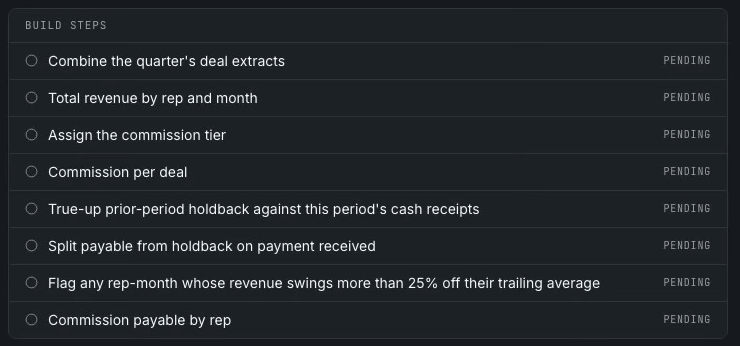
Knowledge base
Policy, captured as rules.
Your policies, procedures, and semantics – captured once, reviewed by you, applied on every run.
See the knowledge base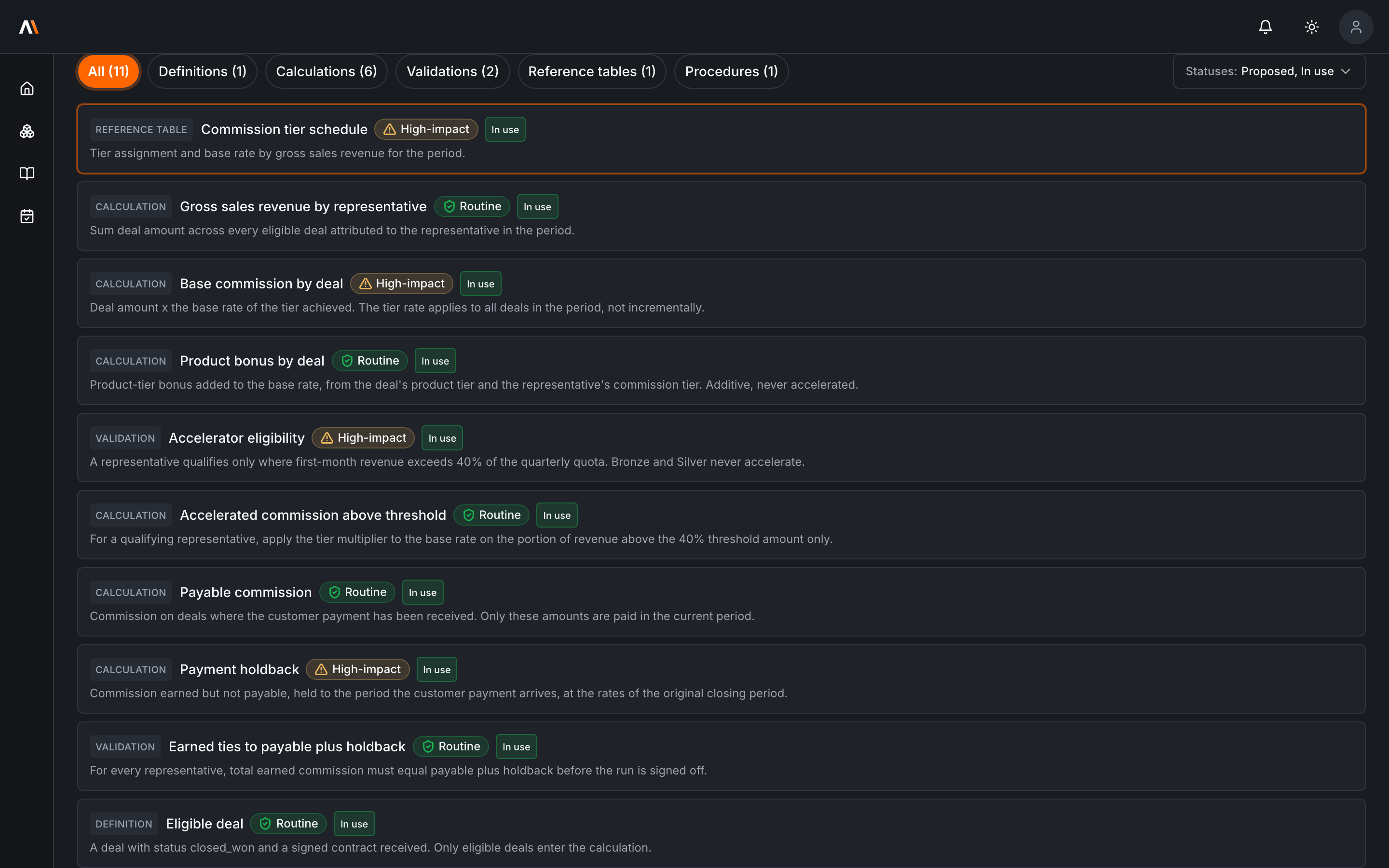
Subledger
The registers between spreadsheets and the ERP.
Investment schedules, contingency logs, audit confirmations – governed like a system of record, flexible like the spreadsheet they replace.
See the subledgerClose management
Know where the close stands.
The close, its tasks, and its evidence in one place – with analytics that show where the month actually went.
See close managementControls
Built to be reviewed.
Role-based access
Preparers, reviewers, and controllers see exactly what their role allows.
Versioned operations
No code written at run time – every step is a documented operation, and the run records the version of the set it used.
Review-ready evidence
Each run leaves a working paper a reviewer can walk.
FAQ
The questions we get.
What is Assertion – an ERP, a close tool, or something else?
Neither. Assertion is the preparation-and-review layer that sits between your ERP and the spreadsheets around it: workflows that run the work as documented operations. Your ERP stays the system of record. We don't fit one category on purpose – the sole mission is to 10x preparer and reviewer productivity, and the roadmap is whatever gets there, whichever category it falls in.
Why can't we just use ChatGPT or Claude?
For preparation, you can – the models are genuinely good at the work. The gap is review. A chat leaves you an answer and a transcript; ask how a number was produced and you're relying on inquiry, which accounting has never accepted as evidence. Assertion runs the work through a fixed set of documented operations, so every run leaves lineage a reviewer can walk.
Why not vibecode accounting work ourselves?
Because the scripts are the easy part. What you'd own afterwards is a pile of generated code with no roles, no lineage – and no realistic way of reviewing without understanding SQL or Python, or reperforming the work. The control environment for reviewers is part of the product, not just automation.
Does Assertion replace my team?
No – we're not selling AI autonomy. Assertion strips the mechanical part out of preparation and review of accounting work so the hours go to judgment.
Is our data used to train models?
No. We use model providers only through API or business tiers whose terms exclude training on your data. Full policy text on the security page.
Are you SOC I or II certified?
Not yet – the audit is on the roadmap, and it will cover the practices already documented on the security page. If you're evaluating and need more, write to security@assertion.so.
Early pilot
We're onboarding a handful of early teams.
Tell us where your close hurts. That answer doesn't go to a sales queue – it goes to the founders who write the roadmap. Pilot teams get early access, and first say in what we build next.